Monitoring and Evaluation
Effective Monitoring & Evaluation of community development programs can improve management, accountability, participation, trust, learning, efficiency and development impacts. Monitoring is as much about building relationships, trust and mutual learning as it is about collecting and reporting data. Wide participation in monitoring is critical because diverse stakeholder groups are working towards overlapping but not precisely the same goals. Relevant tools in this section include Logical Framework Analysis, Participatory Indicator Development, Goal Attainment Scaling, Community Scorecards, Global Reporting Initiative and Social Impact Analysis.
FEATURED RESOURCES
This tool is in draft format and under review. It is intended to help corporate community development practitioners who are not experts in monitoring and evaluation to design, implement and assess their programs in ways that include communities in the definition and realization of success, and as result have the intended impact. Importantly, this should be used as a launch pad for local application--adaptation will be essential.
This study explores how communities and companies can engage in co-planning and monitoring to ensure sustainable local development benefits from the extraction of resources. Within the context of a spectrum of participation a variety of tools and mechanisms are presented in the paper. Some of these tools have been used primarily in the public sector, however companies stand to benefit from the tools in forms that are adapted to context, as they are potential vehicles to increase transparency, and thus accountability of companies, communities and governments.
The ISO 14000 family addresses various aspects of environmental management. It provides practical tools for companies and organizations looking to identify and control their environmental impact and constantly improve their environmental performance. ISO 14001:2004 and ISO 14004:2004 focus on environmental management systems. The other standards in the family focus on specific environmental aspects such as life cycle analysis, communication and auditing.
This guide highlight good practice in designing participatory monitoring programs as a form of socio-environmental management. The concepts and examples presented here are drawn from the many experiences and cases of the extractive industries. Best international practice has served as a guiding principle to organize the information and to incorporate the lessons learned from these experiences.
Companies concerned about their social and environmental impacts have a new tool for measuring and monitoring their activities. the Measuring Impact Framework to help companies measure and assess the impact of their business activities on economic and broader development goals wherever they operate.
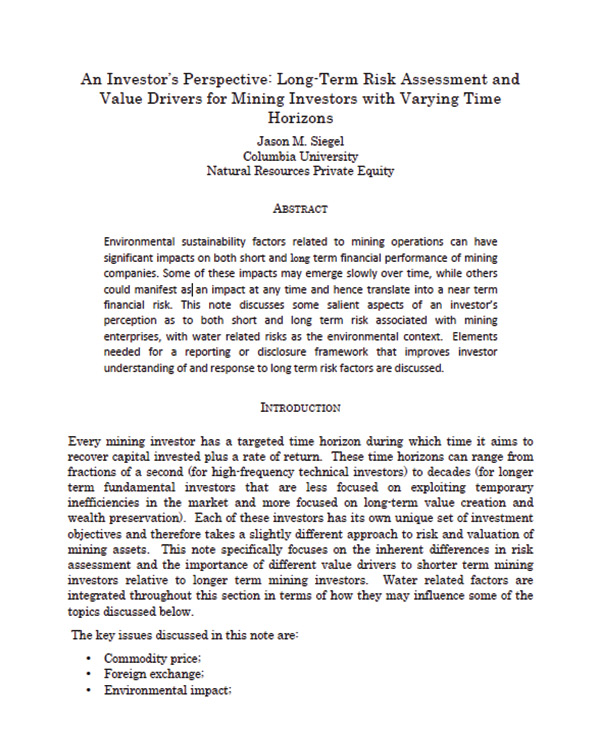
The term “resource curse” was coined to reflect the paradox in which some resource-rich nations have achieved less economic growth than other countries with poor mineral potential. As part of a broad effort to better understand the factors that either inhibit or promote social and economic development linked to largescale mining projects, the ICMM launched an action-research project known as the Resource Endowment Initiative with the World Bank Group, the United Nations, and various stakeholders. One of its key goals is to find ways to ensure better social and development outcomes from large-scale mining investments.
The guide outlines the use of Social Impact Assessments by the oil and gas industry. It provides managers of existing oil and gas operations or new projects with an understanding of how to make the best use of SIAs.
A partnership comprised of International Finance Corporation, Rio Tinto Alcan and Deloitte with additional support from the Government of Norway and the Multilateral Investment Guarantee Agency has successfully developed a pilot version of the Planning and Financial Valuation Tool for Sustainability Investments that quantifies the value of sustainability investments, allowing the user to plan according.