Land Acquisition and Resettlement

Large-scale land acquisitions have become a major topic of policy discussion in recent years.
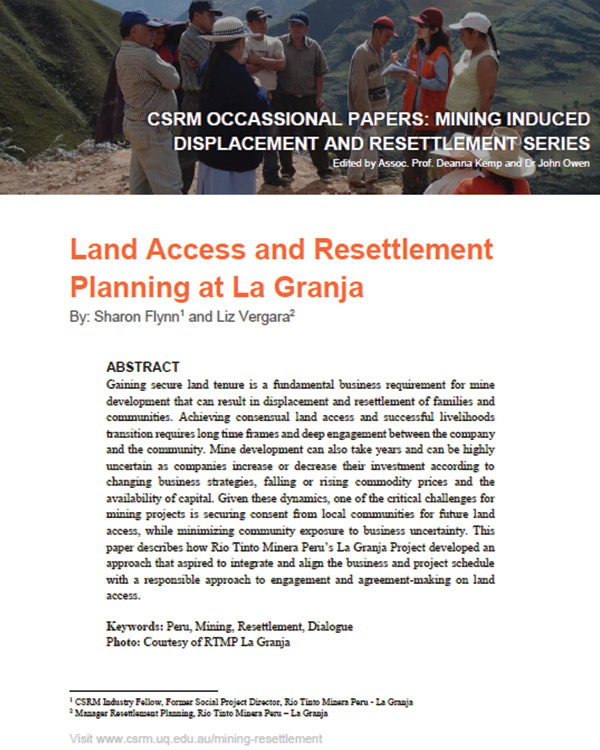
There are significant risks associated with acquisition of land for large scale projects and could result in major conflicts with local stakeholders if not managed well. Land conflicts often have extensive negative effects on economic, social, spatial and ecological development. This is especially true in developing countries and countries in transition, where land market institutions are weak, opportunities for economic gain and illegal action are widespread and many poor people lack access to land. Projects requiring land acquisition and resettlement of communities to allow for project development typically develop a Resettlement Action Plan, which outlines plans for the replacement of housing, infrastructure, services, and utilities and the restoration of displaced households' livelihoods.
FEATURED RESOURCES
The purpose of this handbook is to provide guidance in the planning and execution of involuntary resettlement associated with IFC investment projects. IFC’s policy on involuntary resettlement applies to any project that may result in the loss of assets, the impairment of livelihood, or the physical relocation of an individual, household, or community. The audience for this handbook includes: IFC clients; host government agencies that support private investment in development projects; nongovernmental organizations; and the people whose lives and livelihoods will be affected by projects financed by IFC.
Land conflicts often have extensive negative effects on economic, social, spatial and ecological development. This is especially true in developing countries and countries in transition, where land market institutions are weak, opportunities for economic gain and illegal action are widespread and many poor people lack access to land. Land conflicts can have disastrous effects on individuals as well as on groups and even entire nations. Many conflicts that are perceived to be clashes between different cultures are actually conflicts over land and related natural resources.
Land degradation, which effects more than 900 million people worldwide and as much as two-thirds of the world’s agricultural land, has important gender dimensions. In many developing countries, women – as farmers and pastoralists, with primary esponsibility for household food production – are the principal users and managers of land. However, within productive landscapes, women are often allotted the most marginal lands with the least secure tenure rights.
Large-scale projects can induce in-migration, which can adversely affect local governments and communities. Until now, little information has been available to describe the phenomenon and promote improved assessment and management. IFC's Projects and People: A Handbook for Addressing Project-Induced In-Migration presents first-of-its-kind guidance on in-migration risk assessment and management.